Your braces came off last month, and the teeth beside your front two look small. Your dentist mentions porcelain veneers. A friend says bonding is cheaper and nobody drills anything. Then a forum thread says someone’s teeth were shaved down for good.
On veneers vs bonding, the friend and the thread are both partly right. Bonding costs less and leaves your tooth almost as it was, but it chips and needs touch-ups. Porcelain lasts longer, and a layer of your tooth is gone for good.
At Let’s Smile Dentistry in Mexicali, our founder Dr. Tomás García thinks of upkeep first. Porcelain keeps its shine and limits less of what you eat and drink. Some resins stain and need maintenance every six to twelve months.
Both can give you the smile you want. They differ in how they are made, how long they last and what they ask of you afterward, and each of those points can tip the choice.
Bonding is shaped on your tooth; a veneer replaces its front
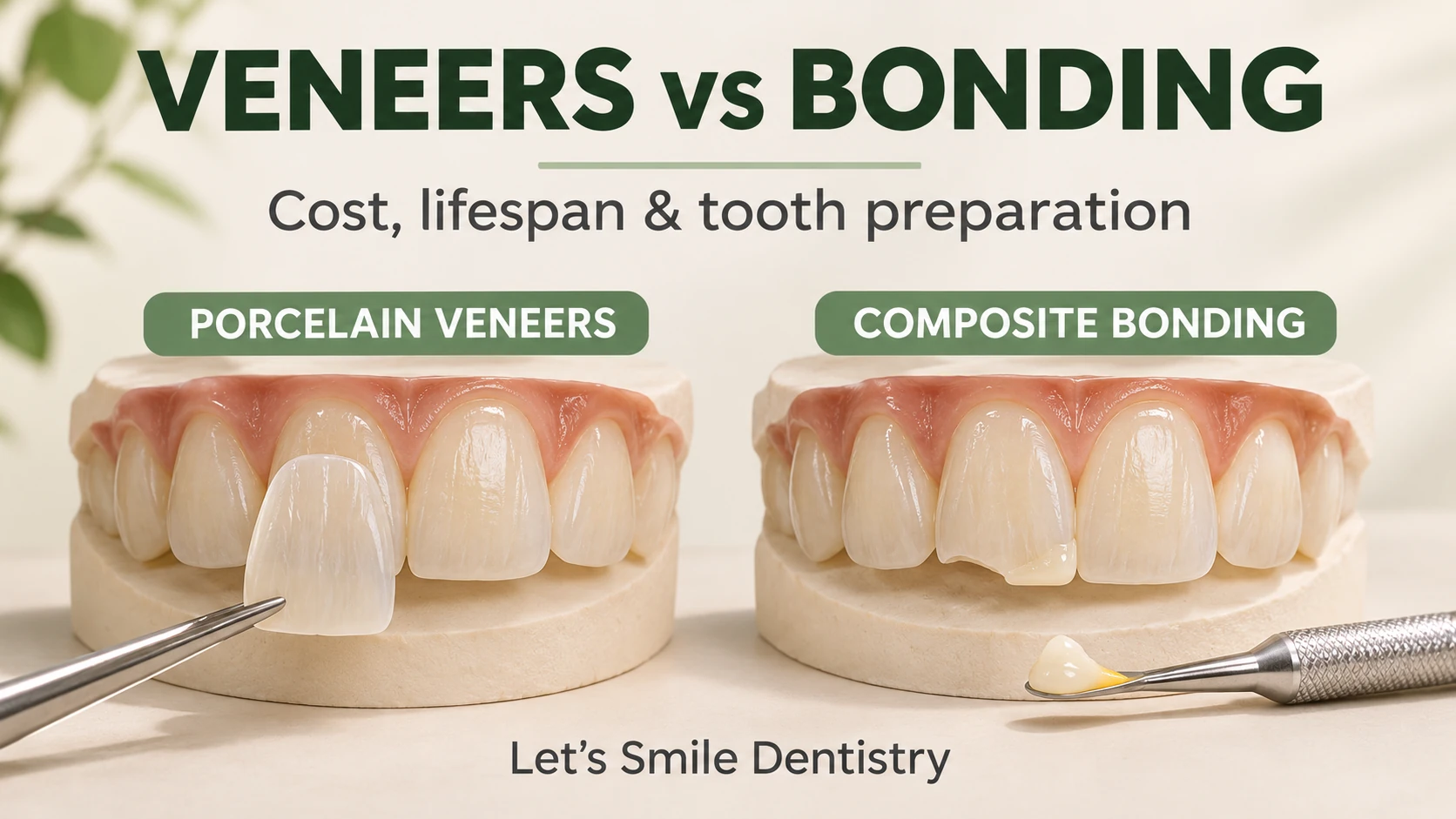
Bonding is composite, a tooth-colored resin. The dentist etches the enamel, the tooth’s hard outer layer, then shapes the resin by hand and hardens it with a light. There is no lab and no temporary.
A porcelain veneer is a thin lab-made shell for the front of the tooth, fitted after the dentist removes a layer of its surface. Composite veneers, resin over the whole front, sit in between.
Where too little enamel is left to bond to, as when an old preparation exposed the dentin, the tooth may need a crown instead, which covers the whole tooth and takes far more of it.
Side by side at Let’s Smile
| Bonding | Porcelain veneer | |
|---|---|---|
| Days in Mexicali, at Let’s Smile | 1 to 2, no temporaries | 2 to 3, with temporaries |
| Tooth removed | Little; the enamel is etched | About half a millimeter of enamel on the front |
| How long it lasts | Years, with touch-ups | Most still in place at about ten years |
| Upkeep | A check and polish every six months | A check every six months |
| Warranty at Let’s Smile | 1 year | 5 years, with the six-monthly checks |
| Let’s Smile’s price, per tooth | $300, composite veneer | $550 |
How long do veneers last?
Porcelain veneers usually last ten years or more. In our experience, porcelain is the more durable of the two and stays stable over the years, with a check every six months.
Research note
Nine long-term studies followed 1,688 porcelain veneers for about ten years, and 96 of every 100 were still in place (Klein et al., systematic review, 2025). By a rough estimate, about a quarter had a chip, crack or gap at the edge along the way, and most of those were fixed without a new veneer. The same review saw fewer complications with lithium disilicate, the porcelain we use, as a trend across studies.
The porcelain Let’s Smile uses
Lithium disilicate, a strong glass-ceramic, is the only porcelain we use for veneers, and we make them in our own lab. We chose it because, across our cases, it gives a natural translucency and wears like enamel.
How long does dental bonding last?
Composite veneers usually need replacing every five to seven years in our patients, and they ask more care in between.
Research note
A small Dutch trial placed both kinds side by side. After up to ten years all 24 porcelain veneers were still in place, while 6 of 24 lab-made composite veneers had failed (Gresnigt et al., clinical trial, 2019). In one private practice’s ten-year records, about 10% of composite veneers needed a repair or a redo each year (Mazzetti et al., practice study, 2022).
Upkeep and repairs
We ask bonding patients to come in every six months for a check and a polish, because food and brushing dull resin. At home, skip abrasive toothpaste and hard-bristled brushes, and go easy on acidic food and drink and on coffee, tea, soda, wine and beer.
Chips and loose pieces get repaired, and our touch-ups cost $90 to $150, depending on their size and complexity.
What a veneer costs your tooth
The standard preparation for a porcelain veneer removes about 0.3 to 0.5 mm from the front of the tooth, which leaves a layer of enamel on most front teeth, and porcelain holds best on enamel. Under the enamel is dentin, the softer living layer of the tooth.
Research note
Front-tooth enamel near the gum line is only about 0.3 to 0.4 mm thick, so even a careful preparation can reach dentin there (Etienne et al., clinical study, 2025). Across six studies, 99 of 100 veneers bonded to enamel were still in place, against 91 of 100 bonded largely to dentin (Alqutaibi et al., meta-analysis, 2025).
How Dr. García plans the preparation
His exam of the bite and of each tooth’s position, shape and color sets how much comes off. Teeth out of line need more, and so do very dark teeth, which need a thicker veneer to hide the color. For several veneers, a smile design first shows whether any reduction is needed.
He also prepares the biting edge, so the veneer wraps over it. In his hands the veneer then fits better, gets a natural edge’s translucency and is less likely to fracture.
Not every dentist works this way, so before anyone drills, ask which design they will use and how much enamel will stay.
Can a veneer be undone?
No. Removed enamel does not come back, so plan as if the veneer were permanent. A replacement veneer also needs enamel to bond to, and a tooth prepared into dentin may need a crown instead.
Sensitivity in the first two weeks
Mild sensitivity after preparation is normal and usually fades over 7 to 14 days. Skip very cold and very hot food and drink for a week, and call us if the pain is severe or getting worse.
If you grind your teeth
Severe grinding can rule out porcelain. We recommend a guard, priced separately, for anyone who grinds or clenches, plays high-impact sports or lifts weights. If you wake up with a sore jaw, mention it first.
Research note
In a Spanish study of 364 porcelain veneers over about five years, veneers broke twice as often in grinders, and seven times as often in grinders who skipped a night guard as in those who wore one (Faus-Matoses et al., clinical study, 2020).
We also ask patients not to bite their nails or hard things, or open anything with their teeth.
Veneers vs bonding cost
Prices range from $90 for a composite touch-up to $550 for a porcelain veneer. Porcelain sits at the top for its durability and quality, and it is the specialists’ pick.
| At Let’s Smile | Price per tooth | Included |
|---|---|---|
| Porcelain veneer | $550 | Specialist, our own lab, digital impression, five-year warranty |
| Composite veneer | $300 | One-year warranty |
| Composite touch-up | $90 to $150 | Priced by the size of the repair |
Prices are as of November 2026 and are not final quotes. A smile design, which we recommend when several teeth are done, adds to the total, and you get your final quote after the exam.
Cost over ten years
If a composite veneer is replaced every five to seven years, ten years means at least two of them, or $600 per tooth before any polishing visits or touch-ups. One porcelain veneer costs $550, and most are still in place at ten years.
Ask for the quote in writing, with what it includes and whether a failure would mean a second trip. Some US dental plans pay part of work done in Mexico, and only your plan can tell you whether yours does.
Which one fits you
Dr. García starts by asking what the patient wants. One patient arrived with composite veneers recommended, weighed the pros and cons of each, and chose porcelain for something that would last without regular maintenance visits or food limits.
For small side teeth after braces, a dentist answering that exact question on a forum said to try bonding first. If it holds, you have your answer. If it chips every year, you have learned something about your bite before you commit enamel to porcelain.
Where we draw the lines
- Bonding suits small chips and worn edges, a tight budget, a quick result, or a patient who wants no tooth removed.
- Porcelain suits gaps, stains that whitening will not move, small defects, and teeth slightly out of line or misshapen, where shape, size and color change together in a smile design.
- We advise against porcelain with severe grinding, too little enamel, short or badly damaged teeth, a bite or habits that would load the veneers, and severe crowding.
Some people need neither yet. Orthodontics comes first if the teeth need it, then whitening, then veneers or bonding, because both are matched to your teeth’s color on the day and neither can be whitened afterwards. A tooth with a good size and shape and no wear needs neither.
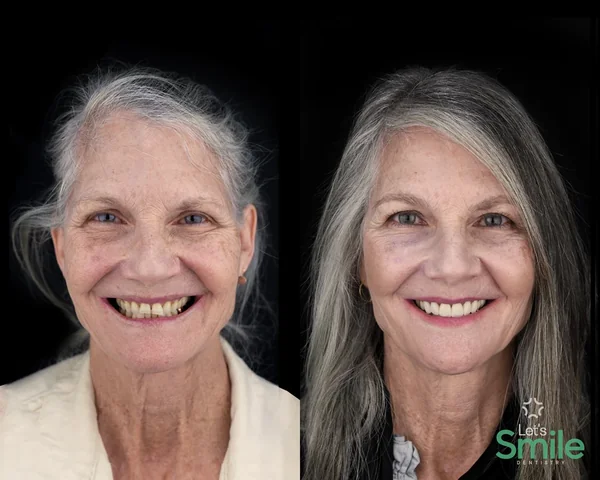
Before-and-after photos are in our gallery.
Getting it done in Mexicali, and what happens once you’re home
Who fixes it once you are home? The American Dental Association advises confirming that follow-up treatment is covered when you return, and considering follow-up care with a US dentist before you travel.
Here are the California Dental Association‘s questions for a clinic abroad that matter for veneers, with our answers.
- Is the work guaranteed, and for how long? Five years on porcelain, with maintenance visits every six months. One year on composite, because the material wears.
- What if something goes wrong once I am home? Contact us as soon as you can, and we will guide you on the next step.
- What can be planned before I travel? Send intraoral photos and x-rays if you have them, and say which treatment interests you. We do the full exam at the clinic, with photos, x-rays, a facial scan and questions about your goals, diet and habits.
- Should I stay an extra night for a bite check? No. Plan two to three days for porcelain and one to two for composite. If a temporary comes off that day or the next, we put it back, so eat soft food while you wear temporaries.
Crossing the border
Our clinic is three minutes by car from the East crossing, the Garita Nuevo Mexicali, and our shuttle picks you up at either Calexico crossing, West or East, or at US-side parking. For the rest of the trip, see dental tourism in Mexicali.
We stand behind every smile we finish. Your price includes our promise that you will be happy with the result, and your warranty travels home with you.
Send us your photos, tell us what you would like to change, and Dr. García will walk you through both options so you can choose the one you will still like in ten years.