
Sticker shock usually hits fast with full-mouth implant treatment. A patient may be told they need a complete rebuild, only to find that the quote feels closer to the price of a car than a dental procedure. If you are asking how much are dental implants for a full mouth, the honest answer is that cost depends on the type of restoration, the number of implants, the condition of your bone, and where you choose to have treatment.
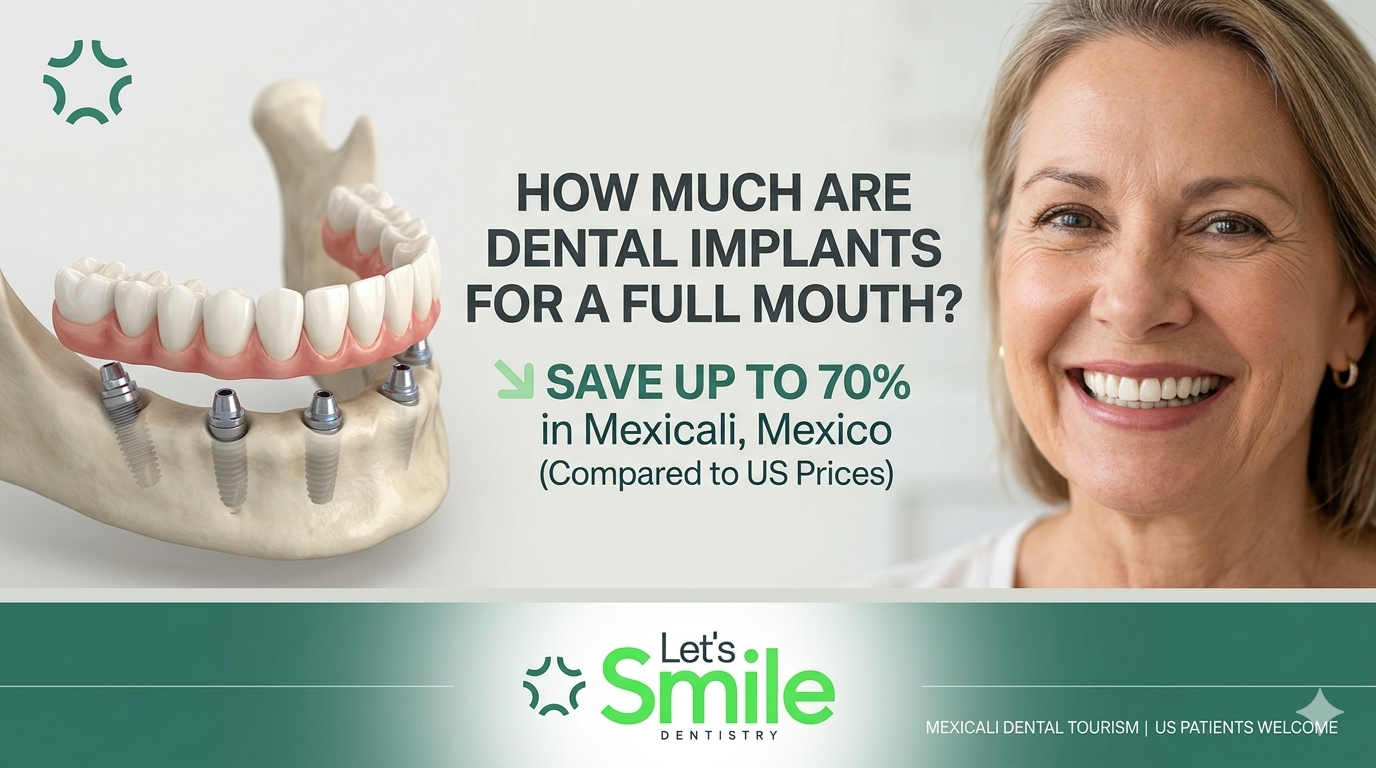
For most patients, a full mouth means replacing all upper and lower teeth with implant-supported restorations. In the United States, that can range from roughly $40,000 to $90,000 or more. In Mexico, the same category of treatment is often significantly more affordable, frequently landing in the range of about $15,000 to $20,000 depending on the case. That is a wide gap, and it is exactly why so many patients from California, Arizona, and beyond start looking at cross-border care.
What counts as a full-mouth implant case?
This is where pricing gets confusing. Not every “full mouth” treatment is the same.
Some patients are candidates for a fixed full-arch solution such as All-on-4 or All-on-6, where a complete upper arch, lower arch, or both are supported by four to six implants per arch. Others need more implants, individual implant crowns, bone grafting, extractions, sinus lifts, or staged treatment because the mouth is in worse condition than it first appears.
A patient with strong bone and no active infection may qualify for a more streamlined approach. A patient with advanced bone loss, failing teeth, and years of wear may need a far more complex rehabilitation, closer to a full mouth reconstruction than a straightforward implant case. Both are technically full-mouth cases, but they will not cost the same.
How much are dental implants for a full mouth in the US?
In the US market, pricing for full-mouth implants often falls into a few broad categories.
A removable implant-supported overdenture is usually the lower-cost option. This may range from around $15,000 to $30,000 per arch, depending on the number of implants used and the materials involved. It offers more stability than traditional dentures, but it is still removable.
A fixed full-arch restoration, such as All-on-4 or All-on-6, is commonly more expensive. Per arch, many US patients see fees in the range of $25,000 to $45,000. For both arches together, total treatment can easily reach $60,000 to $90,000 or more.
If a patient is receiving individual implants for every missing tooth rather than a full-arch system, costs can climb even higher. That approach uses more implants, more components, and often more surgical time. It can be the right solution in some cases, but it is rarely the most cost-effective way to restore an entire mouth.
Why full-mouth implant costs vary so much?
The main reason quotes vary is simple: implant dentistry is not one product. It is a treatment plan built around your anatomy, your goals, and the level of reconstruction required.
The number of implants matters. Four implants per arch will generally cost less than six or more. The type of final prosthesis matters too. A temporary acrylic bridge is not priced the same as a more durable zirconia restoration.
Preparatory treatment can also change the number quickly. Extractions, bone grafting, sinus lifts, treatment for gum infection, sedation, and 3D imaging all affect the final fee. Even the timeline matters. Some patients can move quickly into a same-day or immediate-load plan, while others need healing phases between surgery and final restoration.
Provider experience is another factor. A case planned by a specialist-led team using CBCT imaging, guided surgery, digital design, and high-quality materials may cost more than treatment from a general office using a simpler setup. For a major full-mouth case, many patients feel more comfortable paying for that level of planning and precision.
What you are actually paying for
When patients compare quotes, they sometimes focus only on the implant count. That is understandable, but it can be misleading.
A full-mouth implant fee often includes the surgical consultation, diagnostics, 3D scans, extractions if needed, implant placement, temporary prosthetics, follow-up visits, and the final restoration. In some offices, those items are bundled. In others, they are billed separately, which can make an initial quote look lower than it really is.
Material choice plays a major role as well. Acrylic hybrids are usually more affordable upfront. Zirconia is often more expensive, but many patients prefer it for long-term strength, esthetics, and stain resistance. Neither is automatically better for every patient, and the material you choose is one of the main factors in how long full mouth dental implants last. The right choice depends on bite force, budget, cosmetic goals, and how the case is being restored.
Why many Americans look to Mexico for full-mouth implants
For large restorative cases, the price difference between the US and Mexico is often substantial enough to change what is possible for a patient. Someone who postponed treatment for years because of cost may suddenly be able to move forward.
That lower pricing does not automatically mean lower standards. In established border clinics, patients often find advanced imaging, specialist involvement, modern implant systems, and materials that meet the expectations they would have in the US. The difference is usually tied to lower overhead and operating costs, not to cutting corners.
Convenience also matters. For patients traveling from Southern California or Arizona, choosing a clinic in Mexicali can make treatment far less complicated than flying deeper into another country. Being minutes from the border, with bilingual coordination and help arranging transportation or lodging, removes a lot of the friction that makes people hesitate.
At Let’s Smile Dentistry, that patient support model is part of the value, especially for those managing a complex treatment plan over multiple visits.
What a realistic Mexico price range looks like
For full-arch implant treatment in Mexico, many patients see fees around $8,000 to $10,000 per arch, depending on the restoration type and complexity. For both arches, a common full-mouth range is roughly $15,000 to $20,000. To see what each option includes, compare our full mouth dental implant packages in Mexicali.
Those are broad market ranges. For a concrete comparison, here is how Mexicali dental tourism pricing lines up against typical US and Canadian fees:
| Treatment | US / Canada | Mexicali | Savings |
|---|---|---|---|
| All-on-4, full arch | $25,000–$35,000 | $9,000 | ~70% |
| Full-arch smile makeover | $55,000–$80,000 | $10,500 | ~80% |
| Single implant + crown | $4,000–$6,500 | $1,650 | ~70% |
| Zirconia crown | $1,500–$2,500 | $550 | ~70% |
Those figures are comparison averages, not a quote. Separately, Let’s Smile Dentistry offers all-inclusive full-arch packages at $9,000 per arch or $18,000 for both arches. Each package covers the CT scan and specialist consultations, extractions, bone grafting, up to six implants per arch, temporary and final fixed teeth, three hotel nights, and local and airport shuttle. IV sedation is available on request and is quoted separately. That is why two different numbers can both be honest: one prices the procedure, the other prices the whole trip. Always ask which one you are being quoted.
That estimate can go lower for simpler overdenture cases and higher for premium fixed restorations with more extensive preparatory work. If you are comparing quotes, make sure you know whether the estimate includes temporary teeth, final prosthetics, sedation, imaging, and any needed extractions or grafting. Our breakdown of dental implants in Mexico cost walks through those line items one at a time.
That detail matters more than the headline number. A lower quote is not always the better value if key steps are excluded and added later.
The cheapest option is not always the smartest one
When you are spending this much, value matters more than bargain pricing.
If one office quotes dramatically less than everyone else, ask what kind of implant system they use, who is planning the case, what materials are used for the final bridge, and what happens if adjustments are needed. A full-mouth case is not something most patients want redone because the original plan was rushed or underbuilt.
This is especially true if you have bone loss, clenching habits, health conditions, or old dental work that complicates the case. A more careful treatment plan may cost a bit more upfront but save money, time, and frustration over the years ahead.
Questions to ask before saying yes
Before you move forward with any full-mouth implant plan, ask for a clear breakdown of what is included. You should know how many implants are being placed, whether the restoration is fixed or removable, what the final material will be, and how many visits are expected.
You should also ask who is doing the surgery and who is designing the prosthetic side of the case. Full-mouth success depends on both. Great surgery with poor bite design can still lead to problems. The same is true in reverse.
Finally, ask about contingency planning. If bone quality is lower than expected, if additional grafting is needed, or if healing takes longer, you should understand how that affects the fee and timeline.
Is full-mouth implant treatment worth the cost?
For the right patient, it often is. Full-mouth implants can restore chewing function, improve speech, support facial structure, and replace the daily frustration of loose dentures or failing teeth with something far more stable.
But worth is personal. A patient who wants the lowest possible upfront cost may be happier with a removable option. A patient who wants long-term fixed function and a stronger sense of confidence may decide the higher investment makes sense. Neither choice is wrong if it matches the patient’s health, goals, and finances.
The best next step is not chasing a generic national average. It is getting a case-specific evaluation from a provider who can explain your options clearly, show you what is actually included, and build a plan around your mouth rather than around a price sheet. When the treatment is this important, clarity is just as valuable as the number on the quote.
Full-mouth dental implant costs: common questions
How much do full mouth dental implants cost?
In the United States, full-mouth implant treatment commonly runs from about $40,000 to $90,000 for both arches, depending on how many implants are placed, the material of the final bridge, and whether extractions or grafting are needed. In Mexico, the same category of treatment usually falls between roughly $15,000 and $20,000 for both arches.
How much are full mouth dental implants in Mexico?
In Mexicali, All-on-4 full-arch treatment at Let’s Smile Dentistry starts at $9,000 per arch, against $25,000 to $35,000 in the US and Canada, with a full-arch smile makeover at $10,500. The all-inclusive package for both arches is $18,000 and covers extractions, grafting, temporary and final teeth, three hotel nights, and shuttle transport; IV sedation is quoted separately. These are comparison figures rather than a quote, and your exact price is confirmed at consultation.
What is included in a full-mouth implant price?
A complete quote should cover the surgical consultation, 3D imaging, any extractions, implant placement, temporary teeth, follow-up visits, and the final restoration. Some clinics bundle all of it into one fee. Others bill each step separately, which makes the opening number look smaller than the total. Ask for the breakdown in writing before you compare two quotes.
Is All-on-4 the same as full mouth dental implants?
Not quite. All-on-4 restores a single arch using four implants. A full mouth means both arches, so a full-mouth All-on-4 case is two arches and is priced as such. Some patients also need more than four implants per arch, or individual implant crowns, which changes both the treatment plan and the fee.
How much does full mouth reconstruction cost?
Full mouth reconstruction is broader than implants alone. It can combine crowns, bridges, root canal therapy, periodontal treatment, and implants in one sequenced plan. In Mexicali, a full-arch smile makeover typically runs around $10,500, compared with $55,000 to $80,000 for comparable work in the US and Canada. Because reconstruction plans vary so widely, the only dependable number comes from an examination.